





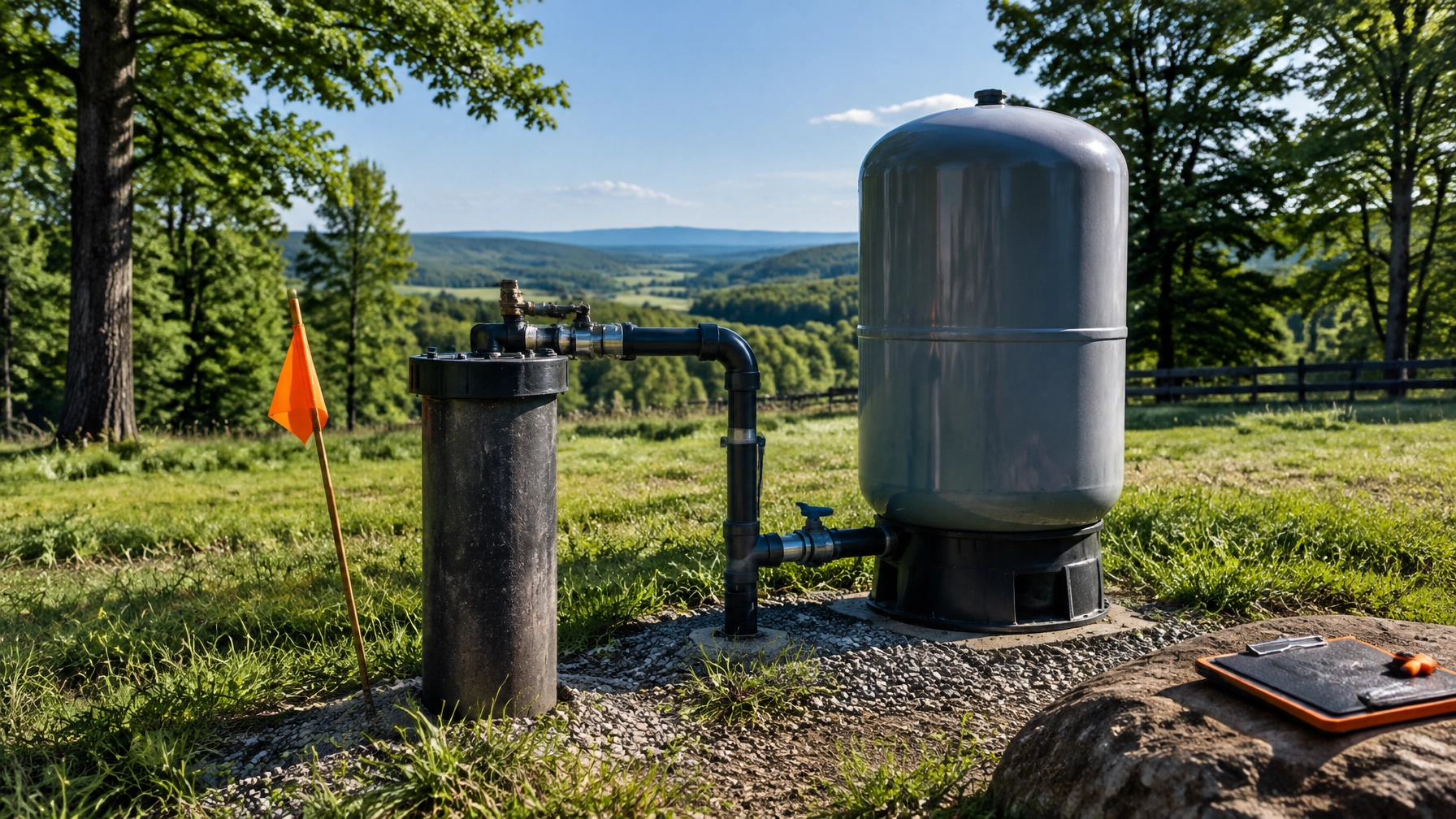

If you are searching for a rural home near Clarksville, Tennessee, do not assume the property uses municipal water. Many homes in rural Montgomery County and Stewart County, along with properties near Palmyra, Woodlawn, and rural Adams, rely on private wells and septic systems.
For buyers moving from a city-water home, a private well can be easy to overlook. You may inspect the roof, HVAC system, foundation, and electrical panel while forgetting to ask whether the water is safe, whether the well produces enough water, or how quickly it recovers after heavy use.
That oversight can create health, maintenance, financing, and resale concerns.
Before purchasing a home with a private water well near Clarksville TN, make the well and septic systems part of your formal due diligence.
What should a private well inspection include?
A private well inspection should evaluate more than whether water comes out of the faucets. Your inspector or qualified well contractor should review:
- The well cap, casing, and visible seals
- The location of the well relative to the septic tank and drain field
- The pressure tank, pump controls, wiring, and filtration equipment
- Static water level and pressure
- Signs of leaks, corrosion, flooding, or surface-water entry
- The well’s production or yield
- Recovery rate after pumping
- Available well records and the Tennessee well driller’s report
- Water quality through an independent laboratory test
Tennessee requires water well drillers, pump installers, and water-treatment device installers to be licensed. The Tennessee Department of Environment and Conservation well-water guidance also explains well construction, separation distances, well records, and testing recommendations.
A home inspection is not a substitute for a well-flow evaluation or certified water analysis. Treat these as separate inspections.

What should a well water test cover?
At a minimum, ask for a certified drinking-water laboratory to test for the following:
1. Total coliform bacteria
Total coliform bacteria serve as an indicator that contamination may be entering the well. A positive result does not always identify the exact source, but it requires follow-up.
Potential causes include:
- A damaged or improperly sealed well cap
- Surface water entering around the casing
- Flooding
- A failing septic system
- Plumbing or pump work
- Poor well construction
2. E. coli
E. coli is a more specific indicator of fecal contamination. It should not be present in drinking water. If the result is positive, stop using the water for drinking and food preparation until a qualified professional and the appropriate health authority advise you on next steps.
3. Nitrates
Nitrates may come from septic systems, agricultural activity, fertilizer, or other sources. They are especially important when a home includes infants, young children, or someone who is pregnant.
4. Iron and manganese
Iron and manganese are commonly quality-of-life concerns rather than immediate health concerns at typical concentrations, but they can cause:
- Orange, brown, or black staining
- Metallic taste
- Odor
- Clogged fixtures
- Damage to water-treatment equipment
5. Hardness
Hard water can create scale on faucets, water heaters, dishwashers, and plumbing fixtures. It can also reduce soap performance and shorten the useful life of appliances.
6. pH
pH helps identify whether the water is acidic or alkaline. An improper pH can contribute to corrosion, staining, metallic taste, and plumbing problems.
The EPA’s private well testing guidance recommends annual testing for total coliform bacteria, nitrates, total dissolved solids, and pH. The EPA also recommends additional testing when local conditions, nearby land uses, flooding, repairs, or changes in taste, odor, or appearance create a reason for concern.
Depending on the property, location, lender, or test history, you may also ask about arsenic, lead, copper, nitrites, chloride, sulfate, and volatile organic compounds.
Tennessee does not impose one universal private-well testing panel for every residential transaction. Your lender may require specific parameters, so ask for the lender’s requirements before ordering the test.
How often should you retest a private well?
For routine ownership, annual testing is a practical standard. At a minimum, test after:
- Flooding or significant heavy rainfall
- Well, pump, or plumbing repairs
- Septic-system repairs
- New construction or land disturbance near the well
- A noticeable change in taste, color, odor, or pressure
- A change in household conditions, such as pregnancy or an infant moving into the home
If a test shows bacteria, do not simply install a treatment device and assume the problem is resolved. The well may need disinfection, repairs, or additional investigation. Retest after corrective work.
For a purchase, the water test should be recent enough to satisfy the lender and underwriting requirements. If you are using VA financing, confirm the timing directly with your lender. A test performed several months before closing may need to be repeated.
How much do well water treatment systems cost?
Treatment costs depend on the contaminant, the water volume, the home’s plumbing, and whether the problem is chemical, biological, or mechanical. As a general planning range, buyers may encounter:
- Water softener: approximately $500 to $2,500 installed
- Iron or manganese treatment: approximately $1,000 to $4,000
- Ultraviolet disinfection: approximately $800 to $2,500
- Sediment or carbon filtration: approximately $500 to $3,000
- Reverse-osmosis drinking-water system: approximately $300 to $1,500
- More complex whole-home treatment: $2,000 to $6,000 or more
These are budgeting ranges, not quotes. A water-treatment company should design the system around laboratory results rather than sell you a generic package.
Some problems cannot be solved economically with a filter. A severely contaminated well, inadequate well construction, or persistent bacterial contamination may require repairs, a new water source, or a new well. Get written estimates during your inspection period.
What are well yield and recovery rate?
A well can have clear water and still fail to meet your household’s practical needs.
Yield is the amount of water a well can produce over time, usually measured in gallons per minute. Recovery rate describes how quickly the water level returns after the well is pumped down.
Ask for documentation showing:
- The tested gallons-per-minute yield
- The static water level
- The pumping water level
- The duration of the test
- The recovery time
- The size of the pressure tank
- Any history of low pressure or running dry
TDEC notes that a well producing approximately 3–5 gallons per minute may adequately serve a household of four to six people, depending on usage and system design. A storage tank can provide additional short-term capacity, but it does not fix an inadequate source.
A property with a large home, multiple bathrooms, irrigation demands, livestock, or frequent guests may require more capacity than a modest household. Ask a qualified well contractor to evaluate the system based on your intended use.

How do lenders and VA appraisers treat private wells and septic systems?
A private well and septic system are not automatically disqualifying for a mortgage. However, the property must meet the requirements of the loan program and lender.
For a conventional loan, the lender may require:
- A recent water-quality test
- A flow or yield evaluation
- Evidence that the well serves the property legally
- Documentation for shared wells or easements
- A septic inspection or certification
- Repairs before closing if the systems create health or safety concerns
For a VA loan, private wells and septic systems can be acceptable when they provide a continuous supply of safe, potable water and a safe method of sewage disposal. VA requirements generally rely on applicable local or state health standards, or EPA guidance when no other standard applies.
The VA water test must typically be completed by a disinterested third party acceptable to the relevant authority and lender. Your lender may also apply a validity period, commonly 90 days, so confirm the exact requirements before scheduling the test.
The VA appraiser evaluates the property for minimum property requirements, but an appraisal is not the same as a technical well or septic inspection. The appraiser may identify visible deficiencies, but you should still hire qualified professionals to test water quality, assess flow, and inspect the septic system.
For current mortgage-rate context, Freddie Mac reported a national average 30-year fixed mortgage rate of 6.95% for the week ending September 17, 2026. You can review the Freddie Mac Primary Mortgage Market Survey for methodology and historical updates. Your actual rate and underwriting conditions will depend on your loan type, credit profile, down payment, property, and lender.
What does Haus flag on rural Clarksville-area properties?
Haus expert contribution from Randy Whetsell: “When we help buyers evaluate rural property, we want them to understand that the well and septic systems are part of the home’s value and future operating cost. We look for documentation, recent testing, visible maintenance concerns, water pressure, well location, access to equipment, and whether the system appears appropriate for the home’s size and intended use. Buyers should not wait until the final days of a contingency period to discover that a lender needs a different test or that a treatment system requires replacement.”
Randy also recommends reviewing the well driller’s report, asking who services the system, and confirming whether the well is individual or shared. A shared well should have clear recorded access and maintenance arrangements that bind future owners.
If you are also considering acreage or a homesite in the area, read Haus’s guide to what you should know before buying land in Stewart County TN. Water availability, septic suitability, access, and utility costs can affect whether rural land is actually buildable.
What should you ask before making an offer?
Before submitting an offer on a rural home, ask:
- Is the property served by an individual or shared well?
- Is there a current water-quality report?
- What contaminants were tested?
- When was the well-flow test completed?
- What is the documented yield and recovery rate?
- Where is the well located relative to the septic system?
- Are well and septic records available?
- Has the well ever tested positive for bacteria?
- What treatment equipment is installed?
- Does the lender require a specific test or inspection?
- Is the septic system sized for the home’s bedroom count?
- Are there recorded agreements for shared water access?
Make your offer and inspection timeline long enough to complete the appropriate testing. If a problem appears, you need time to obtain a second opinion, request repairs or concessions, or reconsider the purchase.
A private well can be a reliable and manageable water source, but it requires informed ownership. If you are moving from city water service, do not skip the test simply because the faucets work and the water looks clear.
Talk with a Haus advisor about a well and septic inspection. Our experienced team can help you identify the right questions, coordinate your buying strategy, and evaluate rural Clarksville-area properties with greater confidence.






