





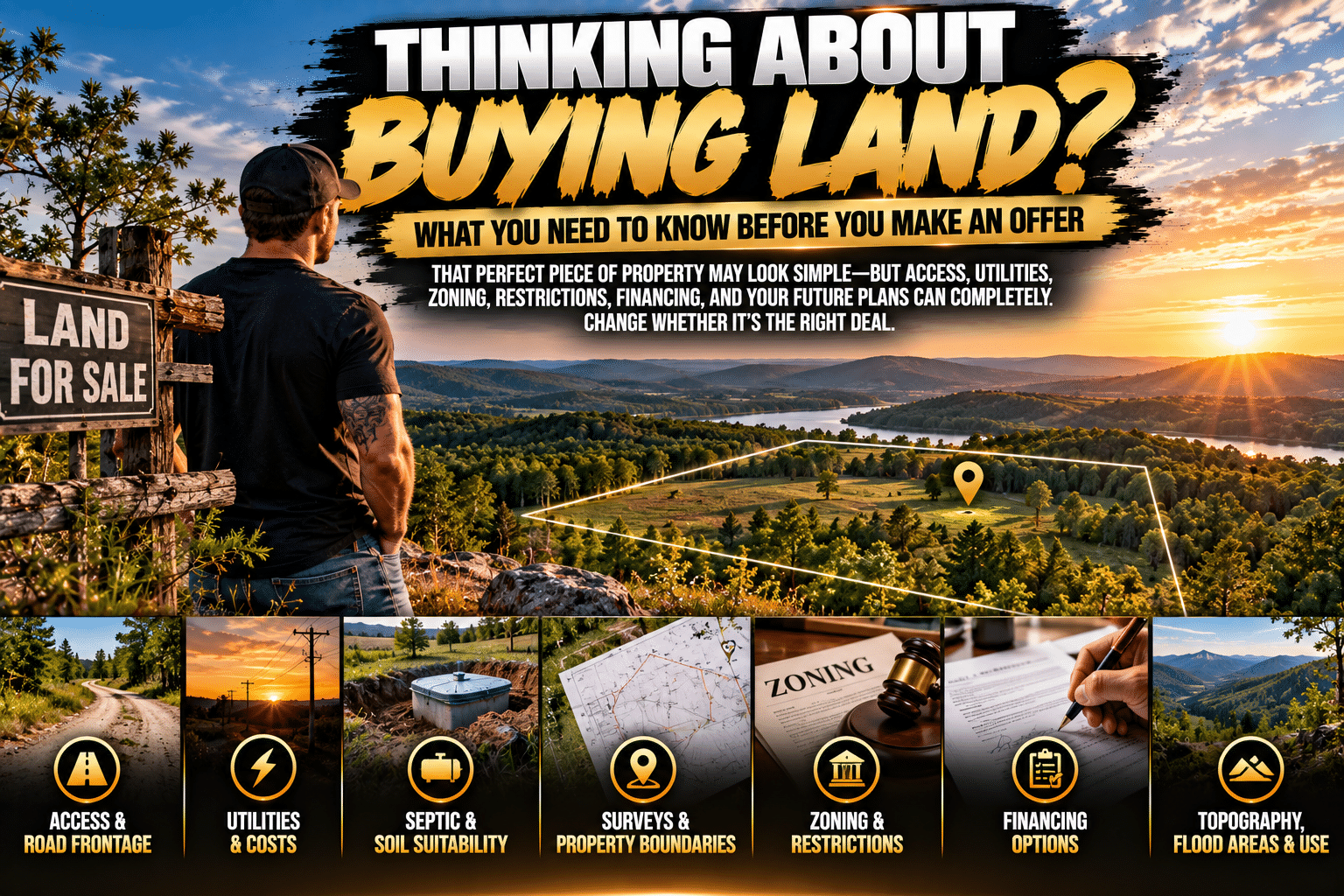

Thinking About Buying Land? What You Need to Know Before You Make an Offer
Buying land looks simple.
There’s no roof to inspect.
No HVAC system to replace.
No outdated kitchen to remodel.
No seller wondering why you don’t appreciate the wallpaper they installed in 1997.
It’s just dirt.
How complicated could it be?
Potentially, very.
Whether you’re looking for a few acres to build your dream home, recreational property, farmland, an investment, or land you hope to develop later, there’s one principle I want buyers to remember:
Being able to buy the land doesn’t necessarily mean you can use the land the way you intend.
A beautiful 10-acre tract may look perfect from the road.
But before making an offer, there are questions about access, boundaries, utilities, septic feasibility, zoning, restrictions, topography, drainage, financing and development costs that can completely change whether that property is actually a good deal.
So before falling in love with the view, let’s talk about the dirt underneath it.
Start With One Question: What Do You Want to Do With the Land?
This should come before almost everything else.
Are you buying land to:
- Build your primary residence?
- Build several years from now?
- Place a manufactured or modular home?
- Build a barndominium?
- Create a small farm?
- Keep horses or livestock?
- Hunt or use it recreationally?
- Build a shop or other structures?
- Divide it into multiple lots?
- Develop it?
- Hold it as a long-term investment?
The answer matters because a property can be perfectly good land and still be completely wrong for your intended use.
Don’t start with:
“Can I afford these 12 acres?”
Start with:
“Can these 12 acres reasonably accomplish what I’m buying them for?”
That’s a much better question.
1. Make Sure You Understand Access
You found 20 beautiful acres.
Fantastic.
Now:
How do you legally get to them?
Seeing a dirt road leading toward the property doesn’t automatically answer that question.
Land access can involve public roads, private roads, recorded easements, shared driveways and other arrangements.
That’s why buyers need to understand both the property’s physical access and the legal rights associated with that access.
Questions may include:
Does the property have direct public-road frontage?
If not, what legal access exists?
Is there a recorded easement?
Who maintains the road?
Who else has the right to use it?
Could the access support the buyer’s intended use?
A property without straightforward access isn’t automatically unusable.
But access shouldn’t be something you discover after closing.
2. Don’t Assume the Fence Is the Property Line
There’s an old fence running down the side of the property.
That must be the boundary, right?
Maybe.
Maybe not.
The same goes for tree lines, old roads, creeks and whatever the seller points toward while saying:
“I think it goes to about that tree over there.”
That’s not how I would want to determine the boundaries of something I’m purchasing.
Surveys and recorded plats can be extremely important in land transactions.
A properly performed survey can help identify property boundaries and may reveal information involving encroachments, easements or other matters relevant to the parcel.
Depending on the property and transaction, existing surveys or plats may be available, or a buyer may consider obtaining a new survey from a Tennessee-licensed professional land surveyor.
Know what you’re actually buying.
“Approximately 10 acres somewhere between that fence and those trees” isn’t quite enough information for me.
3. Zoning Matters
This is one of the biggest reasons you shouldn’t assume:
“It’s my land, so I can do whatever I want with it.”
Land use may be subject to local zoning, subdivision regulations and other governmental requirements.
Depending on the jurisdiction and property, those rules can affect things such as:
- Residential construction
- Commercial use
- Agricultural activities
- Manufactured housing
- Accessory structures
- Setbacks
- Lot dimensions
- Density
- Subdivision
- Certain business uses
- Other development plans
And here’s an important Tennessee-specific point:
Land-use regulation can vary by local jurisdiction.
Counties and municipalities may have their own planning, zoning and subdivision requirements.
So something permitted on one property may not automatically be permitted on another property ten miles away.
Before purchasing land for a specific purpose, verify the applicable requirements with the governmental authority that actually has jurisdiction over that property.
Don’t rely solely on:
“The neighbor did it.”
4. Check for Private Restrictions Too
Government zoning isn’t the only thing that can affect how property is used.
There may also be private restrictions associated with the land.
Those could include recorded restrictive covenants, easements or other title matters.
So even if local zoning allows something, there may be another restriction affecting your particular parcel.
That’s one reason title work matters in land transactions.
If you have a specific intended use, communicate it early so the appropriate professionals can help you determine what needs to be investigated.
5. “It Has Power at the Road” Isn’t the Same as “Power Is Cheap to Install”
Utilities can completely change the economics of a land purchase.
Before buying, investigate what is actually available.
That may include:
- Electricity
- Public water
- Sewer
- Natural gas
- Internet
- Telephone or other communication services
And don’t stop with:
“Is it available?”
Ask:
“What will it take to get it where I need it?”
There can be a huge difference between a utility being somewhere nearby and that utility already being available at your proposed building site.
Distance matters.
Terrain matters.
Utility-company requirements matter.
Easements may matter.
Installation costs matter.
That’s how seemingly inexpensive land can start becoming expensive very quickly.
6. No Sewer? Septic Becomes a Major Question
This is especially important when looking at rural land in Tennessee.
If public sewer isn’t available and you intend to build a home or another structure requiring wastewater disposal, you may need a subsurface sewage disposal system—what most people simply call a septic system.
Tennessee requires a septic-system construction permit before installing a system.
The site may need to be evaluated, and depending on the circumstances, soil information or mapping may be required.
Here’s the part land buyers need to understand:
Owning acreage doesn’t automatically mean every location on that acreage will be suitable for the septic system needed for your plans.
The property’s soil and site conditions matter.
So can the proposed location and size of the home.
Tennessee’s permitting process asks for information including the proposed house site, property lines, driveway, utilities, water sources and other site details.
That’s why I would never recommend treating septic feasibility like an afterthought when you’re purchasing land specifically to build.
7. Don’t Confuse “Perc Test” With the Entire Septic Conversation
You’ll frequently hear people say:
“Does the land perc?”
That’s common shorthand, but the real question is broader:
Can this property obtain approval for an appropriate wastewater system for what I intend to build?
Soil conditions, site characteristics, system design and the proposed structure can all matter.
Tennessee’s TDEC process may involve a site evaluation and, when necessary, soil mapping by an appropriate soil professional.
Alternative septic systems may also exist for certain situations, but those can involve different design and cost considerations.
The important lesson is:
Verify. Don’t assume.
And if a seller says:
“Oh yeah, it should perc.”
The word “should” deserves some follow-up questions.
8. Think About Water Too
If public water isn’t available, how will the property get water?
A private well may be one possibility depending on the property and applicable requirements.
That introduces another set of questions involving feasibility, location, drilling costs, water quality and other considerations.
Again, don’t assume that because surrounding properties have wells, your particular property automatically has everything you need.
Investigate.
9. Look at the Topography
A gorgeous hillside property can make an incredible homesite.
It can also make construction more complicated.
Slope can affect:
- Driveway construction
- Foundation design
- Excavation
- Drainage
- Septic placement
- Accessibility
- Building costs
Meanwhile, very flat land can have its own drainage considerations.
The cheapest acre isn’t always the cheapest acre to develop.
That’s a distinction worth remembering.
10. Water Is Beautiful—Until It’s Where Your House Is Supposed to Be
Creeks, ponds and river frontage can make property incredibly attractive.
They can also introduce additional considerations.
Buyers should investigate applicable flood information, drainage patterns and other water-related conditions when relevant.
A property doesn’t need to have a river running through it for water to matter.
Look at drainage.
Look at low areas.
Look for signs of standing water or erosion.
Ask questions.
Depending on the property, additional professional evaluation may be appropriate.
11. Aerial Maps Are Helpful—But They Aren’t a Survey
Online property maps are fantastic research tools.
I use mapping resources too.
They can help buyers understand the general shape and location of a parcel.
But don’t confuse a mapping overlay with a legally established boundary.
Tennessee’s own state land-use mapping resources caution that their mapping data isn’t intended to establish legal property boundaries.
If the exact boundary matters—and when you’re spending money on land, it usually does—use the appropriate survey and title information.
12. Can You Actually Build Where You Want to Build?
Imagine buying 15 acres because you picture your house sitting on one particular hill overlooking the property.
Then you discover that the location you imagined creates problems involving access, septic placement, utilities, setbacks, easements, terrain or another restriction.
You may still own 15 acres.
But you didn’t buy the homesite you thought you were buying.
That’s why buyers planning to build should think about the specific building area, not simply the total acreage.
Ten acres doesn’t mean ten acres of equally buildable land.
13. Planning to Divide the Property Later? Investigate That BEFORE You Buy
This is especially important for investors.
Maybe you’re looking at 20 acres and thinking:
“I’ll keep five acres and sell the rest as three separate lots.”
Sounds great.
But don’t build your investment analysis around that assumption until you’ve investigated whether the proposed division is actually feasible.
Subdivision can involve local planning requirements, access, road frontage, utility considerations, surveys and septic-related requirements.
Tennessee’s TDEC also has specific processes involving subdivision evaluation when septic systems will serve future development.
Your projected four-lot investment isn’t a four-lot investment simply because you can draw four boxes on an aerial photo.
Verify the development path first.
14. Financing Land Can Be Different From Financing a House
Another surprise for first-time land buyers:
Financing vacant land isn’t necessarily the same as getting a traditional mortgage on an existing home.
Loan availability, down-payment requirements, terms, interest rates and lender requirements can vary considerably depending on factors such as:
- Whether the land is improved or unimproved
- Intended use
- Whether construction is planned
- Available utilities
- Property characteristics
- Borrower qualifications
- The lender and loan product
Some buyers pay cash.
Others use land loans.
Some may eventually use construction-related financing.
The appropriate strategy depends on the buyer and property.
Talk with a lender experienced in land financing before assuming the financing will work like a normal home purchase.
15. Cheap Land Can Become Expensive Land
This deserves its own section.
Imagine two properties.
Property A — $80,000
Property B — $100,000
At first glance:
Property A wins.
You saved $20,000.
Easy decision.
Except Property A may need significantly more work or infrastructure before it can support your intended use.
Maybe you need substantial driveway construction.
Maybe utilities need to travel much farther.
Maybe site preparation is more difficult.
Maybe wastewater requirements are more expensive.
Maybe clearing and grading are substantial.
Meanwhile, Property B may already have easier access to much of what you need.
Suddenly the $20,000 “savings” doesn’t necessarily look like savings anymore.
Don’t compare land using purchase price alone.
Compare what it may cost to turn the property into what you actually want it to become.
16. If You’re Buying Land as an Investment, Know What Creates the Value
Land investing can look deceptively simple.
Buy acreage.
Wait.
Sell it later for more.
Maybe.
But investors should understand what could actually create future demand for that parcel.
Things like:
- Location
- Access
- Development patterns
- Utilities
- Road frontage
- Zoning
- Buildability
- Nearby infrastructure
- Ability to subdivide
- Market demand
can all influence a property’s usefulness and potential future value.
Buying land simply because:
“They’re not making any more of it.”
isn’t an investment strategy by itself.
17. Don’t Skip Due Diligence Because There’s No House to Inspect
When buying an existing home, buyers naturally think:
Inspection.
With vacant land, sometimes they assume there’s nothing to inspect.
In reality, land due diligence can involve an entirely different group of professionals.
Depending on the property and your plans, that might include:
- Professional land surveyor
- Soil professional
- Engineer
- Environmental professional
- Contractor or builder
- Utility providers
- Lender
- Title professional
- Attorney
- Local planning or codes officials
- Appropriate state agencies
You may not need every professional on every transaction.
The property and your intended use should determine what needs investigation.
Before You Make an Offer, Ask These Questions
Before becoming emotionally attached to a piece of land, start here:
What exactly am I buying?
Where are the boundaries?
How do I legally access it?
What easements affect it?
What is the property currently zoned for?
Does my intended use appear to be permitted?
Are there private restrictions?
What utilities are available?
What will bringing those utilities to my building site cost?
If sewer isn’t available, what do I know about septic feasibility?
Where could I realistically build?
What does the terrain look like?
Are there drainage or flood considerations?
If I want to subdivide later, what approvals might be required?
How am I financing the purchase?
What will it cost to turn this land into what I actually want?
Now we’re evaluating the property instead of simply admiring it.
The Best-Looking Land Isn’t Always the Best Deal
There’s something different about walking acreage.
You start imagining things almost immediately.
House over there.
Shop over here.
Driveway coming through those trees.
Maybe a pond.
Maybe some animals.
Maybe split a couple of lots off someday.
And there’s nothing wrong with dreaming.
That’s part of the fun.
Just make sure the research happens before the dream becomes an expensive assumption.
Because the most important question isn’t:
“Do I like this land?”
It’s:
“Can this land realistically do what I need it to do?”
If you’re looking for land in Clarksville or Middle Tennessee, I’m happy to help you search for properties, investigate the real-estate side of the transaction and identify the questions that need answers before you move forward.
Whether you’re looking for a homesite, acreage, recreational property or an investment opportunity, we can start with the goal and work backward.
Because when you’re buying land, sometimes what isn’t immediately visible matters more than what is.
— Jamie Taylor, REALTOR®
Your Tennessee Homes Team
Haus Realty & Management
Serving Clarksville & Middle Tennessee
This article is provided for general educational purposes and is not legal, surveying, engineering, environmental, zoning, septic, construction, lending, tax or investment advice. Land-use regulations, zoning, subdivision requirements, utility availability, septic feasibility, access rights, restrictions, financing and development requirements vary by property and jurisdiction. Buyers should independently verify information with the governmental agencies and appropriately licensed professionals responsible for the specific property and intended use.






