





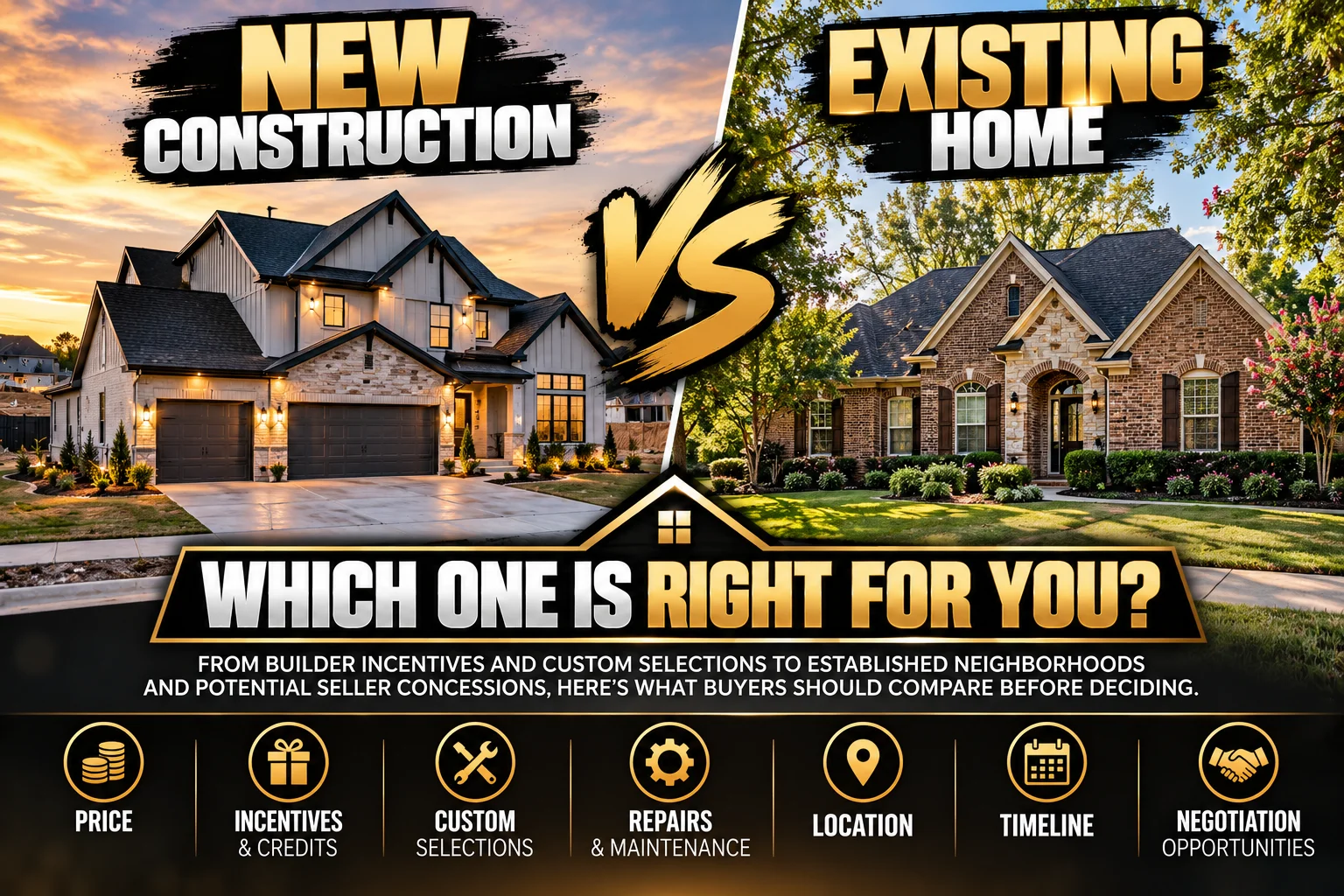

New Construction vs. Existing Home: Which One Is Right for You?
You’re ready to buy a home, and then one of the first big decisions shows up:
Do I buy brand-new construction—or an existing home?
It’s easy to picture the difference.
With new construction, you may get that fresh-paint smell, untouched appliances, modern finishes and the possibility of choosing some of the details yourself.
With an existing home, you may get mature trees, an established neighborhood, improvements already completed and a house that’s ready for you to make your own.
But deciding between the two involves a lot more than deciding whether you want something new.
Price matters.
But so do incentives, financing, location, lot size, selections, upgrades, maintenance, warranties, timelines, negotiation opportunities and what is actually included with the home.
So before deciding which direction is right for you, let’s compare the bigger picture.
New Construction: There’s Something Nice About Being First
There’s an obvious appeal to buying a home nobody else has lived in.
Everything is new.
The appliances may be new.
The roof is new.
The HVAC system is new.
The flooring, cabinets, fixtures and finishes are new.
That can potentially mean fewer immediate maintenance concerns than purchasing an older property—although new certainly doesn’t mean a home can never have issues.
Depending on when you enter the construction process, you may also have opportunities to make selections that allow the home to feel more like yours before you ever receive the keys.
And then there’s something buyers sometimes overlook:
Builder incentives.
Before You Buy New Construction, Ask About Builder Incentives
This is one of the first conversations I’d want to have when looking at a new construction community.
What incentives are currently available?
Builders sometimes offer incentives to encourage buyers to purchase particular homes, close within certain timeframes or use affiliated or preferred financing providers.
Those incentives can vary tremendously.
Depending on the builder, community and current promotion, potential incentives might include:
- Contributions toward eligible closing costs
- Financing incentives
- Interest-rate buydowns
- Design or selection allowances
- Appliance packages
- Included upgrades
- Reduced pricing on certain inventory homes
- Lot-related incentives
- Other promotional credits or allowances
But here’s the important part:
Never assume an advertised builder incentive applies to every home or every buyer.
An incentive may only apply to certain completed or inventory homes.
It may have a contract deadline.
It may require closing by a particular date.
It could be connected to using a builder’s preferred or affiliated lender or title provider.
And the incentive available on one floor plan or homesite may be completely different from what’s available on another.
That’s why the question shouldn’t simply be:
“Does the builder have incentives?”
Ask:
“What incentives are available on THIS home, what are the requirements to receive them, and how do they affect my total cost?”
Don’t Just Look at the Price—Compare the Entire Deal
Imagine you’re comparing two homes.
One is an existing home listed at $390,000.
The other is a new construction home priced at $400,000.
Looking only at the purchase price, the existing home appears to be $10,000 cheaper.
But what if the builder is currently offering an eligible closing-cost contribution or financing incentive on the new home?
What if certain appliances are included?
What if the existing home already has a fence, blinds, upgraded landscaping and other improvements that you’d otherwise have to purchase after closing?
Now the comparison becomes much more interesting.
This is why buyers should avoid comparing homes based solely on the number printed beside Purchase Price.
Look at the entire financial picture:
Purchase price
Financing terms
Cash needed at closing
Potential builder or seller contributions
Taxes
HOA expenses, when applicable
Included features and upgrades
Immediate improvements you may want or need
Expected maintenance
And the monthly payment
Sometimes the lower-priced home creates the lower overall cost.
Sometimes it doesn’t.
Run the numbers.
New Construction May Give You Choices—But Ask What’s Actually Available
One of the fun parts of building or buying early in the construction process can be making selections.
Depending on the builder, community, construction stage and contract, buyers may have opportunities to choose certain:
- Flooring
- Cabinets
- Countertops
- Paint colors
- Fixtures
- Hardware
- Exterior finishes
- Appliances
- Other design options
But don’t walk into every new construction home assuming you’re going to design it from scratch.
There is a big difference between purchasing a home early in the construction process and purchasing a spec or inventory home that’s already substantially completed.
On an inventory home, many—or all—of the selections may already have been made.
And even when selections are available, there’s another question to ask:
What’s included in the base price, and what’s considered an upgrade?
That beautiful model home may contain options that aren’t standard in the home you’re considering.
So when touring a model, don’t be shy.
Ask:
Is this standard?
Is this an upgrade?
What would this option cost in my home?
Those questions can prevent surprises later.
Existing Homes Have Their Own Advantages
New construction gets plenty of attention because, well…
It’s new.
But don’t overlook what an existing home may offer.
An established property may already have things such as:
- Fencing
- Mature landscaping
- Window treatments
- Decks or patios
- Storage buildings
- Finished bonus spaces
- Established lawns
- Upgraded fixtures
- Appliances
- Other improvements made by previous owners
Those things have value.
A new construction buyer may move into a beautiful new house and then realize:
“Oh. Now I need blinds for every window.”
And a fence.
And landscaping.
And maybe a refrigerator.
And maybe a patio.
Suddenly that post-closing shopping list gets pretty long.
With an existing home, some of those improvements may already be there.
Established Neighborhood or Growing Community?
Location isn’t just about how far the home is from work.
The type of community matters too.
An existing home may be located in an established neighborhood where the surrounding homes, landscaping, traffic patterns and general environment are already easier to observe.
A new construction home may be in a developing community where additional homes, roads, amenities or construction activity could continue around you for some time.
Neither is automatically better.
Some buyers love watching a new community develop around them.
Others prefer moving somewhere that already feels established.
When considering new construction, ask what is currently planned for the surrounding development.
And remember that future plans can change.
Lot Size and Location Within the Community Matter
Don’t compare only floor plans.
Compare the actual homesites.
Two homes with the exact same floor plan can feel completely different depending on where they’re positioned.
Consider:
- Lot size
- Backyard usability
- Topography
- Nearby roads
- Cul-de-sac versus through street
- Adjacent common areas
- Proximity to amenities
- Surrounding construction
- Drainage characteristics
- What may eventually be built nearby
Some new construction communities may also have lot premiums, where certain homesites cost more because of size, location or other characteristics.
Ask about that too.
What About Maintenance and Warranties?
New construction may offer the advantage of newer major systems and builder or manufacturer warranties.
But buyers should understand exactly what’s covered, by whom and for how long.
Ask for warranty information.
Read it.
Understand how warranty requests are submitted.
And don’t assume that because a home is new, an inspection isn’t worthwhile.
New doesn’t automatically mean perfect.
Construction involves a lot of people, materials and moving pieces.
An independent home inspection can still provide valuable information about the property you’re purchasing.
Existing Homes May Require More Immediate Maintenance
On the resale side, the age and condition of major components deserve attention.
Things like:
Roof
HVAC
Water heater
Windows
Plumbing
Electrical components
Appliances
Exterior materials
may have different remaining useful lives depending on the home.
That doesn’t make an existing home a bad purchase.
It simply means you should understand what you’re buying.
A well-maintained existing home may be an excellent option.
An older home with several major systems approaching replacement may require a different financial plan.
That’s one reason inspections and property-specific due diligence matter.
Negotiation Looks Different With a Builder
When purchasing an existing home, you’re typically negotiating with an individual seller.
With new construction, you’re usually dealing with a builder operating within its own pricing, inventory and sales strategy.
That can change the conversation.
A builder may prefer offering an incentive instead of reducing the advertised purchase price.
There may be more flexibility on one inventory home than another.
A completed home that’s ready to close may have different incentives from a home that won’t be finished for several months.
This is why asking what’s currently available matters.
Builder promotions can change.
Inventory changes.
And an incentive that existed last month may not exist today.
The Builder Has a Sales Representative. Do I Still Need My Own Agent?
This is something buyers should understand before walking into a new construction sales office.
The professionals working for the builder are there to facilitate the builder’s sales process and represent the interests they’re engaged to represent.
That doesn’t mean they’re doing anything wrong.
It simply means buyers should understand who represents whom.
Having your own real estate professional can give you someone focused on helping you understand the transaction from the buyer’s side.
That can include helping you compare properties, evaluate incentives, understand what’s included, review comparable market information, coordinate inspections and communicate throughout the transaction within the scope of the agent’s role.
And there’s one particularly important piece of advice:
If you want your own REALTOR® involved in a new construction purchase, talk to your agent before your first visit to the builder.
Builders can have their own registration and agent-participation policies.
Don’t assume you can tour the model, register yourself, negotiate with the builder and then bring an agent into the transaction later under the same terms.
Get your representation figured out before you start touring communities.
Builder Financing Incentives Deserve a Closer Look
A builder may advertise an attractive interest rate or substantial lender credit through an affiliated or preferred lender.
That’s absolutely worth exploring.
But don’t stop at the advertisement.
Ask for the complete numbers.
Compare:
Interest rate
APR
Loan costs
Discount points
Lender credits
Cash needed at closing
Monthly principal and interest
Mortgage insurance, when applicable
Loan terms
And any requirements attached to the incentive
An attractive incentive may genuinely provide substantial value.
But you won’t know that until you compare the whole financing package.
Your lender or mortgage professional should help you evaluate the actual numbers.
Existing-Home Sellers Can Offer Incentives Too
Builder incentives aren’t the only concessions available in real estate.
Depending on the property, market, offer and financing involved, an existing-home seller may also agree to contribute toward eligible buyer closing costs or other negotiated items.
That means the comparison shouldn’t be:
“Builders give incentives and homeowners don’t.”
Instead, compare the actual opportunity available on each property.
What is this builder offering?
What might this seller consider?
What does my financing allow?
What does each scenario do to my cash needed at closing and monthly payment?
That’s the comparison that matters.
Timeline Can Be a Major Difference
If you’re purchasing a completed new construction home, you may be able to move relatively quickly.
If you’re purchasing something still being built, the timeline may be very different.
Construction schedules can also change because of weather, materials, labor, inspections and other factors.
If you have a firm moving deadline, ask how that timeline will be handled.
With an existing home, you’re generally purchasing something that’s already physically there and ready for the transaction process to begin.
That can provide more certainty about exactly what you’re buying and potentially when you’ll be able to move.
But every transaction is different.
So Which One Is Better?
Neither.
Seriously.
There’s no universal winner between new construction and existing homes.
The better question is:
Which one fits what YOU care about most?
If you value newer systems, modern designs, potential builder incentives and the possibility of making selections, new construction may deserve serious consideration.
If you value an established neighborhood, mature landscaping, existing improvements, potentially larger or different lot characteristics, or a particular location, an existing home may make more sense.
And plenty of buyers start their search convinced they want one and end up purchasing the other.
That’s okay.
Compare Before You Decide
If you’re buying in Clarksville or Middle Tennessee, my advice is simple:
Don’t eliminate either option before you’ve actually compared them.
Tour some new construction.
Tour some existing homes.
Ask what builder incentives are currently available.
Find out which selections are still available.
Ask what’s standard and what’s an upgrade.
Look at potential seller concessions on resale properties.
Compare financing.
Compare monthly payments.
Compare cash needed at closing.
Compare location.
Compare the homes themselves.
Then decide which combination makes the most sense for you.
You don’t have to walk into the process already knowing the answer.
That’s what the search is for.
And if you’re considering new construction, bring me into the conversation before your first builder visit so we can understand the builder’s current agent-registration requirements and start comparing the options from the beginning.
Whether the home has been standing for twenty years or the paint dried yesterday, the goal is the same:
Find the home—and the overall deal—that makes sense for you.
— Jamie Taylor, REALTOR®
Your Tennessee Homes Team
Haus Realty & Management
Serving Clarksville & Middle Tennessee
This article is provided for general educational purposes. Builder incentives, seller concessions, financing programs, interest rates, upgrade availability, warranties, pricing and real estate market conditions can change and vary by property, builder, lender and buyer. Buyers should verify current incentives and terms directly with the appropriate builder, lender and real estate professionals before making a purchasing decision.






