





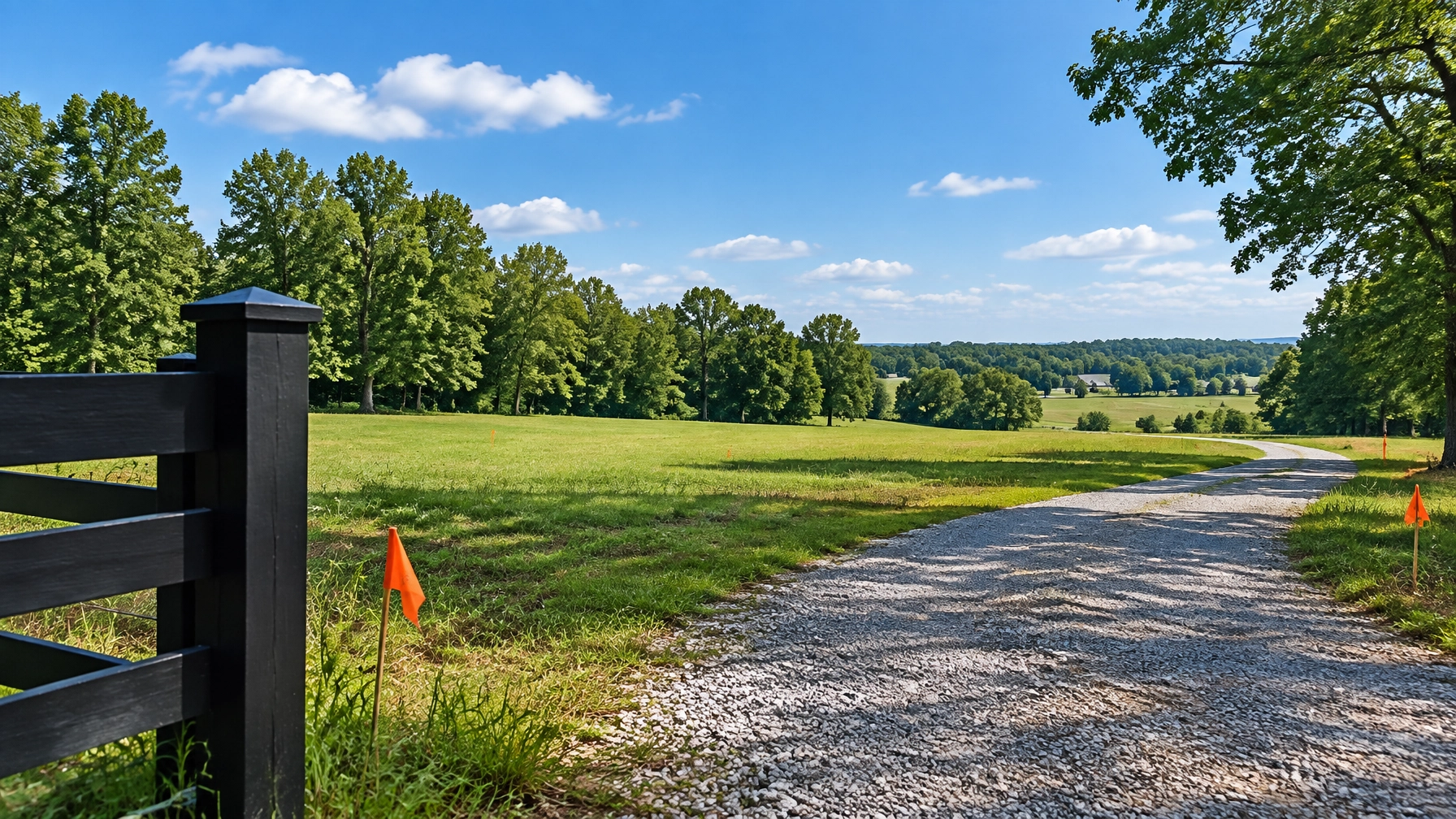

Buying land in Christian County KY can give you the flexibility to build a home, establish a small farm, or create more space within a short drive of Fort Campbell and Hopkinsville. However, acreage purchases require more due diligence than a typical home purchase.
You are not only buying the land itself. You are also evaluating access, utilities, soil, permitted uses, financing, taxes, and the practical cost of making the property buildable.
This step-by-step guide explains what to confirm before you make an offer or close on Christian County acreage.
Why are buyers looking at Christian County acreage?
Christian County land is attracting buyers who want to build within a short drive of Fort Campbell rather than purchase inside Hopkinsville city limits. For military families, that can mean more privacy, room for a shop or detached garage, and a larger homesite while remaining connected to the installation and nearby communities.
Some buyers are looking for:
- A homesite with several acres
- A small farm or hobby farm
- Land for a custom-built home
- An investment or future homesite
- Property with access to Hopkinsville, Oak Grove, or Fort Campbell
- Acreage outside a more traditional subdivision
Start by identifying your intended use. A parcel that works well for farming may not be suitable for a septic-based home, and land that appears ideal for residential construction may have access, drainage, or utility limitations.
You can review local area information on Haus’s Christian County communities page.
Step 1: Determine whether the property is buildable
What should you check before making an offer?
Before you become committed to a parcel, confirm whether your planned use is realistically possible. Ask the listing agent for available surveys, plats, deed restrictions, utility information, previous soil evaluations, and any records concerning access or easements.
Your initial review should include:
- Total acreage and parcel dimensions
- Whether the property is vacant, agricultural, or previously developed
- Existing structures, ponds, fences, or leases
- Floodplain or drainage concerns
- Deed restrictions and conservation easements
- Road frontage and legal access
- Water, sewer, electric, internet, and gas availability
- Whether the parcel is inside Hopkinsville, Oak Grove, or another city
- Whether it is located in unincorporated Christian County
Do not assume that an “available” utility is already connected to the property. In many rural areas, a listing may mean that a utility line is somewhere nearby, not that service is available at the proposed homesite.
Step 2: Order a current boundary survey

A current boundary survey is one of the most important safeguards when buying acreage. It confirms what you are actually purchasing and can reveal problems that are not obvious during a property tour.
A Kentucky-licensed surveyor can help identify:
- Property corners and boundary lines
- Actual acreage
- Road frontage
- Recorded easements and rights-of-way
- Encroachments
- Fences that do not follow the legal boundary
- Utility corridors
- Access points
- Restrictions that affect development
Your offer should include a survey contingency when appropriate. If the survey shows substantially less land than advertised, no legal access, or an easement that interferes with your building plans, you may need the right to renegotiate or terminate the agreement.
Road frontage deserves special attention. A driveway that appears to connect to a public road may require an entrance permit, sight-distance approval, culvert installation, or other improvements. If the property is located on a busier route near Fort Campbell or Hopkinsville, access requirements may be more restrictive.
Confirm whether you have direct access to a public road or whether access depends on a recorded private easement.
Step 3: Confirm septic and soil feasibility
Why does a perc test matter when buying Kentucky acreage?
If public sewer is not available, you will likely need an onsite sewage system. A property’s size does not guarantee that it can support a septic system in the location where you want to build.
Christian County’s official process involves a soil and site evaluation through the Christian County Health Department. The evaluation helps determine whether the property can support an onsite sewage system and where that system may be located.
Before closing, confirm:
- Whether a prior soil evaluation exists
- Whether it applies to your proposed homesite
- Whether the property has a current septic permit
- Where the drain field and reserve area would be located
- Whether slopes, rock, wetlands, or seasonal water affect the site
- Whether a septic system would limit future additions or outbuildings
People often use the phrase “perc test,” but the official evaluation may involve more than a simple percolation test. Ask the health department what documentation and testing are currently required for your specific parcel.
Your purchase contract should make the transaction contingent on a satisfactory soil evaluation if septic service will be necessary. Confirm current fees, forms, and requirements directly with the local health department before relying on older records or information from a listing.
Step 4: Verify water, electric, and other utilities
Utilities can significantly change the cost of developing land.
Water
Ask the relevant city or county water district whether service is available at the property line. Confirm:
- The exact location of the nearest water main
- Tap and connection fees
- Line-extension costs
- Required easements
- Water pressure and capacity
- Whether the proposed homesite can be served by the existing system
“County water available” should be treated as a starting point for verification, not a guarantee of immediate connection.
Electric
Electric service may be provided by a municipal utility or an electric cooperative, depending on the property’s location. Contact the provider before you close and ask whether power is already at the road, at the property line, or on the parcel.
Request information about:
- Line-extension costs
- Transformer requirements
- Service capacity
- Easements
- Construction timelines
- Three-phase power, if your intended use requires it
Also confirm internet, natural gas, and telephone availability at the exact property address. Rural service maps may not accurately reflect actual installation costs or speeds.
Step 5: Review planning, subdivision, and zoning requirements
Does Christian County have zoning restrictions?
The answer depends on the property’s location and your intended use.
Inside Hopkinsville or Oak Grove, city zoning and development regulations may affect permitted uses, setbacks, lot size, building placement, and required approvals. In unincorporated Christian County, subdivision and land-development requirements still matter even when a traditional city-style zoning classification may not apply in the same way.
The Hopkinsville-Christian County Planning Services Division is a useful starting point for confirming current requirements. Contact the office before closing if you plan to:
- Divide the property
- Build more than one home
- Create a private road
- Add a commercial use
- Operate a business from the property
- Build a barn, shop, or other accessory structure
- Develop a rental or multifamily project
- Change the property’s use
Ask about subdivision approval, minimum road standards, drainage, flood hazards, utility requirements, building permits, and any city-specific rules. If the property is near Fort Campbell corridors or inside a city boundary, additional access or development standards may apply.
Do not rely only on the seller’s statement that “anything can be built there.” Confirm your intended use with the appropriate planning office in writing whenever possible.
Step 6: Understand agricultural status and tax considerations
A parcel may currently be assessed as agricultural because it is used for crops, livestock, pasture, or another qualifying purpose. That classification can affect the property’s tax treatment, but it may not continue after you change the land’s use.
Ask the seller and the Christian County Property Valuation Administrator:
- How the property is currently classified
- What documentation supports the agricultural classification
- Whether the property is enrolled in an agricultural program
- Whether changing the use could trigger additional taxes
- Whether rollback taxes or other adjustments may apply
- Whether a new owner must file an application to maintain the status
If you plan to build a residence, subdivide the property, or convert agricultural land to another use, discuss the potential tax consequences with the PVA and your tax professional before closing.
Step 7: Choose the right type of financing
How is a land loan different from a mortgage?
A traditional mortgage is generally secured by a completed residential property. A land loan finances the land itself, which creates more risk for the lender because there may be no completed home or income-producing structure.
Land loans commonly involve:
- Larger down payments
- Shorter repayment terms
- Higher interest rates
- More detailed appraisal and underwriting
- Stricter requirements for access and utilities
Depending on the lender and the property, you may need a down payment of 15% to 30% or more. Terms may be closer to 10 or 20 years rather than a standard 30-year mortgage.
For context, Freddie Mac’s Primary Mortgage Market Survey reported a 30-year fixed rate of 7.28% for the week ending October 1, 2026. This is a national benchmark for conventional residential mortgages, not a quote for a Christian County land loan. Your land-loan rate may be higher and will depend on the property, your credit profile, down payment, lender, and intended use.
Ask lenders whether they offer:
- Raw land loans
- Improved land loans
- Construction-to-permanent financing
- Farm or agricultural loans
- Lot loans for future home construction
Get pre-approved before making an offer, and confirm that the lender will finance the specific acreage, zoning situation, and utility profile of the parcel you want.
How does Haus help Fort Campbell families buying Kentucky acreage?
Buying acreage near Fort Campbell requires coordination between your real estate agent, lender, surveyor, health department, utility providers, planning officials, and closing professionals.
Randy Whetsell of Haus Realty & Management explains that Fort Campbell families often need help balancing installation access with their long-term plans. Haus guides buyers through the search for suitable Kentucky acreage, helps identify questions about access and utilities, and keeps the due-diligence process organized before the buyer commits to closing.
The goal is not simply to find a large parcel. It is to help you determine whether the land supports the home, lifestyle, commute, and future plans you have in mind.
A practical Christian County land-buying checklist
Before closing, confirm that you have:
- Identified the property’s intended use.
- Reviewed the deed, restrictions, easements, and available records.
- Ordered a current boundary survey.
- Verified legal road frontage and driveway access.
- Completed the required soil or septic site evaluation.
- Confirmed water service and connection costs.
- Confirmed electric availability and extension requirements.
- Reviewed sewer, internet, gas, and drainage conditions.
- Contacted the appropriate planning office.
- Confirmed agricultural classification and possible tax consequences.
- Obtained financing approval for the land-loan structure.
- Included appropriate survey, septic, utility, planning, and financing contingencies.
Requirements can change, and every parcel has its own conditions. Confirm current rules with Christian County Planning Services, the Christian County Health Department, utility providers, the PVA, your lender, and your closing professional.
Ready to explore your options? Ask Haus about Christian County land listings and let our experienced team help you evaluate acreage near Hopkinsville, Fort Campbell, and the surrounding Kentucky communities.






