





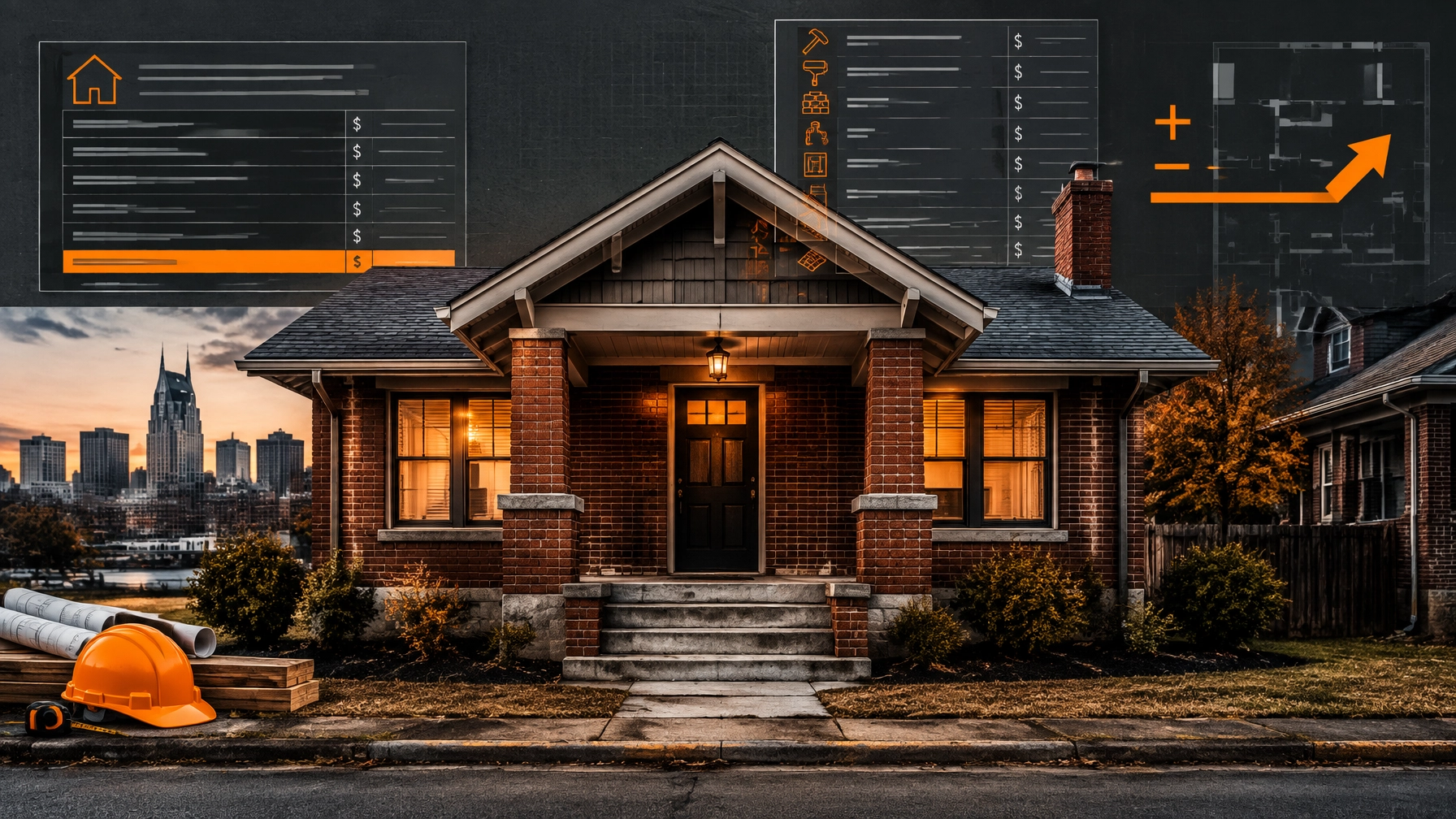

The most common way to finance a fix-and-flip in Clarksville, Tennessee, is with a short-term hard-money loan, private money, or a secured line of credit. The right choice depends on your purchase price, after-repair value (ARV), renovation budget, available cash, experience, and exit strategy.
For most investors, the financing decision should come after the deal has been analyzed, not before. Points, interest carry, draw schedules, holding costs, price reductions, and resale timing can determine whether a promising property produces a profit.
Clarksville’s older inventory near downtown, Peachers Mill, and the Fort Campbell rental belt may offer renovation opportunities. However, Montgomery County is not a market where an optimistic resale price can compensate for weak underwriting. Haus’s September 2026 market snapshot reported approximately 4.9 months of supply, 62 days on market, and price reductions on about 30.4% of active listings. That makes accurate budgeting and realistic pricing essential.
What financing options are available for a Clarksville flip?
Hard-money financing
Hard-money loans are short-term, asset-based loans designed for investment properties. The lender typically focuses on the purchase price, renovation plan, property condition, ARV, and your proposed exit strategy.
Common features may include:
- Six- to 12-month terms, sometimes with extension options
- Interest-only payments
- Two to three points or more
- Interest rates higher than traditional mortgage rates
- Purchase and renovation funds structured together
- Rehabilitation money released through draws
- A maximum loan amount based on a percentage of ARV
The main advantage is speed. A qualified investor may be able to close faster than with conventional financing, which can matter when competing for an older property.
The tradeoff is cost. A loan with attractive leverage can still damage your returns if the rate, points, extension fees, inspection charges, or draw requirements are expensive.
Private money
Private money comes from an individual or private investment group rather than a conventional lender. The lender could be a local investor, business owner, family member, or experienced real estate partner.
Private-money terms are negotiable, which may allow you to structure:
- A lower interest rate
- Flexible payment timing
- A longer maturity date
- Funding for a larger portion of the project
- Equity participation instead of fixed interest
However, flexibility does not eliminate risk. Put the agreement in writing and address the interest rate, collateral, payment schedule, default provisions, draw process, decision-making authority, and exit timeline. A private relationship should not replace professional loan documentation.
A local credit union line of credit
A local credit union may offer a home-equity line, business line, construction line, or portfolio product that can be used for investment purposes. These products may have lower rates than hard money, but they often require stronger credit, documented income, collateral, personal guarantees, and an established banking relationship.
A credit union line may work well when you already own property with substantial equity. It may be less useful for a first-time flipper who needs rapid acquisition financing or a lender willing to fund renovation draws based on ARV.
Ask whether the line can be used for:
- Investment-property purchases
- Contractor payments
- Materials and labor
- Multiple projects
- Interest reserves
- Properties held in an LLC
Do not assume a line of credit is automatically approved for a flip simply because it is secured by real estate.

How does the 70% of ARV rule work in Clarksville?
The 70% rule is a screening guideline, not a guaranteed formula. It generally means you try to keep the project’s total cost near or below 70% of the property’s after-repair value.
A simplified calculation is:
Maximum acquisition price = ARV × 70% − renovation costs
That calculation does not fully account for loan points, interest, closing costs, taxes, insurance, utilities, selling expenses, commissions, or unexpected repairs. Those costs must be included before you decide whether the deal works.
Consider these planning examples:
| Estimated ARV | 70% of ARV | Renovation budget | Initial acquisition ceiling |
|---|---|---|---|
| $300,000 | $210,000 | $45,000 | $165,000 |
| $375,000 | $262,500 | $55,000 | $207,500 |
| $450,000 | $315,000 | $60,000 | $255,000 |
These are not Clarksville valuation estimates. They show how quickly the purchase-price ceiling changes as the property moves into a different resale range.
In older downtown homes, the purchase price may look attractive while electrical, plumbing, foundation, drainage, or roof work consumes the margin. Around Peachers Mill, your resale analysis should account for the specific buyer pool, competing renovated homes, and nearby rental alternatives. In the Fort Campbell rental belt, an investor may have a rental fallback, but the property still must meet tenant expectations for condition, layout, parking, and location.
The 70% rule is most useful when it forces you to leave room for expenses you cannot see at the first showing.
Why does the renovation budget matter more than the loan terms?
A slightly lower interest rate cannot rescue a severely underestimated rehab budget.
Before applying for a rehab loan for investors in Clarksville, prepare an itemized scope of work that includes:
- Demolition and disposal
- Roofing and exterior repairs
- HVAC, plumbing, and electrical work
- Windows and doors
- Kitchen and bathroom finishes
- Flooring, paint, and lighting
- Landscaping and cleanup
- Permits and inspections
- Contractor overhead
- A contingency reserve of at least 10% to 20%
Older Montgomery County homes can reveal problems only after walls, ceilings, or floors are opened. Get written contractor estimates and confirm which items require permits or specialized trades.
A lender may approve the original budget but refuse to increase the loan when costs rise. You must have enough liquidity to fund overruns, delayed draws, and expenses outside the approved scope.
How do points, interest, and draws affect your cash?
Suppose a lender offers a $225,000 loan at 12% interest with three points.
- Three points equal approximately $6,750
- Monthly interest-only payment is approximately $2,250
- Six months of interest equals approximately $13,500
That is more than $20,000 in financing cost before property taxes, insurance, utilities, lawn care, permits, or selling expenses.
Rehabilitation funds are also often released in draws rather than delivered all at closing. A typical process may require you to:
- Submit a detailed scope and budget.
- Complete an approved phase of work.
- Provide invoices, receipts, photographs, or inspection access.
- Wait for the lender to approve and release the draw.
- Use the next draw to fund the following phase.
Ask the lender how long draw approvals take, whether inspections have a fee, whether materials are reimbursed before installation, and how much cash you need before the first draw.

How do interest rates affect a flip’s exit strategy?
The Freddie Mac Primary Mortgage Market Survey reported a national average 30-year fixed mortgage rate of 6.95% for the week of September 17, 2026. That is a residential mortgage benchmark, not a hard-money quote, but it matters when your exit strategy depends on a retail buyer or refinance.
For illustration, a fully amortizing $300,000 30-year loan at 6.95% produces principal and interest of approximately $1,986 per month. At a rate one-quarter percentage point lower, approximately 6.70%, the payment would be about $1,936 per month. A difference of roughly $50 per month before taxes and insurance.
Review the dated Freddie Mac PMMS archive for the official rate record.
For a flipper, the larger concern is often not the eventual buyer’s payment. It is the cost of carrying your project while it remains unfinished or unsold. Montgomery County’s reported 62-day average marketing period means you should stress-test the deal for additional time after construction is complete.
Model at least:
- Your planned renovation period
- Several weeks for listing preparation
- The local marketing timeline
- Buyer inspection and appraisal time
- The closing period
- A possible price reduction
What does Haus recommend from the investor and property-management side?
From the Haus investor and property-management perspective, a flip should have a credible backup plan before you close.
If the resale market softens, you may need to rent the property, refinance it, reduce the price, or hold it longer. That decision should be based on realistic rent, operating expenses, insurance, taxes, maintenance, vacancy, and management costs, not on a hopeful rental estimate.
Haus provides additional guidance in its Clarksville rental-property investing guide and its overview of Clarksville property management services.
A rental fallback is not automatically profitable. It is simply another exit option that should be evaluated before the project begins.
Are licenses or contractor qualifications required for a Tennessee flip?
Possibly. Buying and reselling a property you own is different from performing construction work for other people, but renovation work may trigger licensing, permit, and trade requirements.
The Tennessee Board for Licensing Contractors states that a contractor license is required before contracting, bidding, offering to engage, or negotiating a price for projects of $25,000 or more when acting as a prime contractor, certain subcontractor, or construction manager.
Electrical, plumbing, HVAC, roofing, structural, and other scopes may involve separate qualifications or licensed trades. Local permits and inspections may also apply in Clarksville and Montgomery County.
Confirm the requirements for your project with the appropriate Tennessee and local authorities before work begins. This article is not legal, construction, tax, or lending advice.

Frequently asked questions
Can I finance a Clarksville flip with a conventional mortgage?
Sometimes, but conventional loans are generally designed for owner-occupied or stabilized properties. A property requiring major repairs may not qualify, and the timeline may not fit a competitive investment purchase.
Is hard money better than private money?
Neither is automatically better. Hard money may provide speed and a defined process. Private money may offer more flexibility. Compare the total cost, collateral requirements, maturity date, draw rules, and relationship risks.
How much cash should I keep available?
Maintain cash for your down payment, points, closing costs, upfront work, overruns, and several months of holding costs. Your lender’s approved budget is not a substitute for personal reserves.
Is the 70% rule mandatory?
No. It is a rule of thumb used to screen potential deals. Your actual target may need to be more conservative when renovation uncertainty, days on market, or price-reduction risk is elevated.
Should I keep the property as a rental instead?
Run both exit strategies before purchasing. A rental may provide a backup option, but it must work after management, vacancy, maintenance, insurance, taxes, and financing costs.
The bottom line
Financing a fix and flip in Clarksville TN requires more than finding a lender willing to fund the purchase. You need a realistic ARV, an itemized renovation budget, adequate reserves, a workable draw schedule, and an exit strategy that accounts for Montgomery County’s current marketing timeline.
Compare hard money, private money, and local credit union options by their total project cost, not just their interest rate. Then stress-test the deal for construction overruns, price reductions, and additional holding time.
Request a Clarksville rental-property analysis if you want to evaluate whether a resale or rental strategy better fits your property and investment goals.
Market figures and rate information are dated to the sources identified above. Financing terms vary by lender, borrower, property, and project. Consult qualified lending, tax, legal, construction, and real estate professionals before making an investment decision.






