





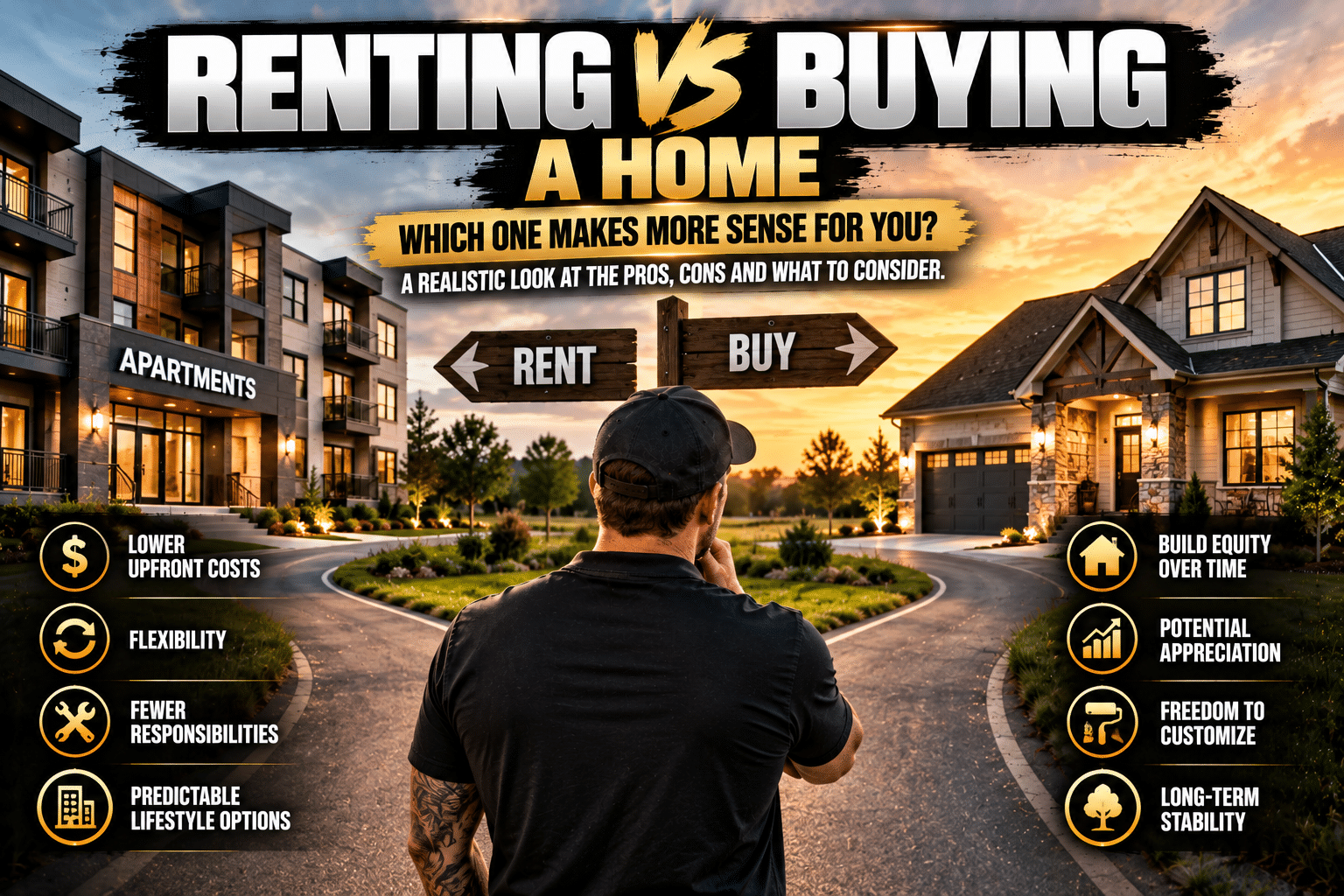

Renting vs. Buying a Home: Which One Makes More Sense for You?
You’ve probably heard some version of this before:
“Why are you throwing money away on rent when you could be paying your own mortgage?”
It sounds convincing.
It also oversimplifies one of the biggest financial decisions most people will ever make.
Because renting isn’t automatically wasting money.
And buying isn’t automatically building wealth.
The better choice is the one that fits your finances, timeline, and life right now.
For some people, buying a home can provide stability, greater control over where they live and the opportunity to build equity over time.
For someone else, renting may provide exactly the flexibility and lower level of responsibility they need.
So instead of starting with:
“Is renting or buying better?”
Let’s ask a much more useful question:
“Which one makes more sense for me right now?”
The Case for Renting
Let’s give renting the credit it deserves.
There are situations where renting can make a lot of sense.
Maybe you’re new to an area and aren’t sure where you want to settle.
Maybe your job could relocate you.
Maybe you’re rebuilding your finances.
Maybe you don’t have enough savings to comfortably handle the upfront and ongoing costs of homeownership.
Maybe you simply don’t want the responsibility of maintaining a property right now.
That’s okay.
Buying a house isn’t a requirement for becoming a successful adult.
Sometimes renting gives you something extremely valuable:
Flexibility.
Advantage of Renting: It’s Easier to Move
If your life could change significantly within the next few years, renting may provide more flexibility than owning.
Maybe you’re:
- In the military and could receive PCS orders
- Considering a job change
- Planning to relocate
- Going through a major life transition
- New to Clarksville or Middle Tennessee
- Unsure how long you’ll stay in the area
A lease still creates obligations, of course.
But selling a house is generally much more involved than ending a rental arrangement according to the terms of a lease.
Buying and later selling also involves transaction expenses.
So if you think there’s a strong possibility you’ll move relatively soon, that’s something worth considering before purchasing.
Advantage of Renting: Major Repairs Usually Aren’t Your Responsibility
Your air conditioner quits.
Your water heater stops working.
There’s a plumbing issue.
If you’re renting, you typically contact the landlord or property manager, subject to the responsibilities established by your lease and applicable law.
When you own the home?
Congratulations.
You’re the landlord now.
That means repairs and maintenance can become your financial responsibility.
Homeownership requires planning for more than the monthly mortgage payment.
Things break.
Roofs age.
HVAC systems eventually need service or replacement.
Appliances stop working.
Plumbing develops problems.
Trees need maintenance.
The house doesn’t care that you already spent your extra money that month.
Advantage of Renting: Upfront Costs May Be Lower
Buying a home can require significantly more money upfront.
Depending on the transaction and financing, buyers may need funds for things such as:
- Down payment
- Closing costs
- Inspections
- Appraisal-related costs
- Prepaid expenses
- Homeowners insurance
- Moving expenses
- Immediate repairs or purchases
Some buyers may qualify for loan programs, assistance or negotiated seller contributions that reduce certain upfront expenses.
But those possibilities should be evaluated for the individual transaction rather than assumed.
Renters also have upfront expenses—such as deposits, application costs, moving expenses and other charges depending on the property—but the financial commitment can look very different from purchasing.
Disadvantage of Renting: You Aren’t Building Ownership in the Property
This is one of the strongest arguments for buying.
When you pay rent, you’re paying for the right to occupy someone else’s property according to your lease.
You don’t gain ownership of the property from those monthly payments.
A homeowner with a mortgage, on the other hand, may gradually build equity as principal is repaid.
Property values can also increase over time, potentially increasing equity further.
But there’s an important word there:
Potentially.
Home values don’t move in only one direction.
Real estate markets change, and appreciation is never guaranteed.
Buying a home shouldn’t be based on the assumption that:
“It will definitely be worth more next year.”
Disadvantage of Renting: You Have Less Control
Want to paint the bedroom?
Get a dog?
Replace the flooring?
Install something on the wall?
Change the landscaping?
Your lease and landlord may have something to say about that.
Renters generally have less control over the property because they don’t own it.
Lease renewal terms and rental rates may also change.
Depending on the lease, property and applicable law, the owner may eventually decide not to continue renting the property.
That’s one of the tradeoffs of flexibility.
You have fewer ownership responsibilities—but also less ownership control.
Now Let’s Look at Buying
Homeownership comes with responsibilities renting doesn’t.
But it also offers benefits renting can’t provide in quite the same way.
For the right person, at the right time and with the right financial preparation, purchasing a home can make a lot of sense.
Advantage of Buying: You Can Build Equity
This is one of the primary financial differences between renting and owning.
When you make a mortgage payment, part of that payment may go toward reducing the principal balance of your loan.
As that balance decreases, your ownership interest in the property can grow.
If the property’s market value also increases, your equity may increase further.
That equity may eventually become a significant financial asset.
But again:
Equity isn’t guaranteed profit.
Market conditions, transaction costs, property condition, improvements, mortgage balance and the eventual sales price all affect what a homeowner may ultimately receive when selling.
Advantage of Buying: Greater Stability
Homeownership can provide a level of housing stability that many people value.
If you have a fixed-rate mortgage, the principal-and-interest portion of your payment is generally fixed for the life of that loan.
However, that doesn’t mean your total housing expense can never change.
Property taxes may change.
Homeowners insurance premiums may change.
HOA dues may change where applicable.
Maintenance expenses certainly change.
That’s why comparing your current rent to only a mortgage’s principal-and-interest payment doesn’t give you the entire picture.
Advantage of Buying: It’s Yours
Want the blue bedroom?
Paint it blue.
Want to replace the flooring?
Go for it.
Want to remodel the kitchen?
That’s your decision—subject, of course, to applicable laws, permits, HOA restrictions and other requirements.
Ownership gives you significantly more control over your living environment.
For some people, that’s a huge quality-of-life benefit.
Advantage of Buying: Potential Long-Term Appreciation
Historically, residential real estate has provided wealth-building opportunities for many homeowners over long periods.
But that doesn’t mean every property appreciates at the same rate—or at all during every period.
Location matters.
Condition matters.
Purchase price matters.
Market conditions matter.
How long you own the property matters.
So I wouldn’t tell someone:
“Buy this house because it’ll definitely go up in value.”
Nobody can responsibly promise that.
Instead, potential appreciation should be considered one possible benefit of long-term ownership—not a guarantee.
Disadvantage of Buying: You’re Responsible When Things Break
This deserves repeating.
When you own the house, the repair bill generally belongs to you.
The first time your HVAC stops working on the hottest day of July, you’ll quickly discover that homeownership has a sense of humor.
That’s why buyers shouldn’t drain every dollar they have just to get through closing.
Having money left for emergencies and maintenance matters.
Being able to purchase a house and being financially comfortable owning a house aren’t necessarily the same thing.
Disadvantage of Buying: Selling Isn’t Free
People sometimes calculate homeownership like this:
Bought for $300,000.
Sold for $350,000.
Made $50,000.
Not necessarily.
Selling a home can involve transaction expenses and other costs.
Depending on the situation, those may include real estate compensation, closing-related expenses, repairs, concessions, moving costs and other expenses.
That matters especially if you only plan to own the property for a short period.
The shorter your expected ownership period, the more important it becomes to consider the costs associated with buying and eventually selling.
Disadvantage of Buying: Less Flexibility
A great job opportunity appears three states away.
A relationship changes.
You decide Clarksville isn’t where you want to stay.
Your family needs change.
If you’re renting, relocating may primarily involve dealing with the terms of your lease.
If you own a home, you have another major decision:
What do I do with the house?
Sell it?
Keep it as a rental?
Can you qualify to purchase somewhere else while still owning it?
How quickly could it realistically sell?
Ownership can provide stability.
But stability and flexibility often sit on opposite sides of the same scale.
Don’t Compare Rent to Only the Mortgage Payment
This is one of the biggest mistakes people make when deciding whether to buy.
Suppose you’re paying $1,800 in rent.
Then you see a mortgage estimate with $1,750 in principal and interest.
Easy decision, right?
Not necessarily.
A homeowner’s actual housing expense can also involve things such as:
- Property taxes
- Homeowners insurance
- Mortgage insurance when applicable
- HOA fees when applicable
- Maintenance
- Repairs
- Utilities that may have previously been included in rent
- Lawn care or exterior maintenance
- Other property-related expenses
At the same time, renters should consider the possibility of future rent increases and the fact that rent payments generally don’t create ownership in the property.
Compare the whole picture—not two monthly numbers.
Renting May Make More Sense Right Now If…
Renting may deserve serious consideration if:
- You expect to move relatively soon.
- Your employment or location is uncertain.
- You don’t yet have sufficient savings for purchasing and maintaining a home comfortably.
- You’re actively rebuilding credit or improving your financial position.
- You have significant debt you’re working to reduce.
- You aren’t ready for maintenance and repair responsibilities.
- You’re new to an area and want time to learn where you’d prefer to live.
- Buying would leave you with little or no emergency savings.
- You simply aren’t ready to commit to a property.
And notice something important:
None of those mean:
“You’ll never be ready to buy.”
Sometimes renting isn’t the alternative to buying.
It’s part of the preparation for buying later.
Buying May Make More Sense Right Now If…
Buying may deserve serious consideration if:
- You expect to remain in the area for a meaningful period.
- Your income and employment situation are reasonably stable.
- You have sufficient funds for the transaction while maintaining appropriate reserves.
- You’ve spoken with a qualified lender and understand what you can comfortably afford.
- You want greater control over your living space.
- You’re comfortable accepting responsibility for maintenance and repairs.
- Homeownership fits your longer-term goals.
- You’ve found a property and payment structure that work within your budget.
Notice I didn’t say:
“Buy because rent is expensive.”
High rent alone doesn’t automatically make purchasing affordable.
You still need to evaluate the numbers.
What About Military Buyers?
Around Clarksville and Fort Campbell, this question comes up frequently.
Military families may have access to VA home-loan benefits, which can make purchasing attractive for eligible borrowers.
But there’s another side of the equation:
PCS orders.
If you don’t know how long you’ll remain in the area, the potential length of ownership deserves consideration.
That doesn’t mean military buyers shouldn’t purchase homes.
Plenty do.
It simply means the decision should consider both the benefits of ownership and the possibility of relocation.
Before purchasing, think ahead:
If I receive orders sooner than expected, what might I do with this property?
Could selling make sense?
Would keeping it as a rental be realistic?
What financial position might I be in?
You can’t predict every future PCS.
But you can think beyond closing day.
Don’t Buy a House Just Because Someone Says You “Should”
This might be the most important section in this article.
Your parents bought their first house at 23.
Your coworker says renting is throwing money away.
Someone on social media says real estate is the only way to build wealth.
None of those people live your financial life.
Buying a home is a major commitment.
If purchasing would leave you unable to handle a normal repair, struggling every month to make the payment, or unable to maintain emergency savings, becoming a homeowner may not feel nearly as exciting six months later.
There’s nothing wrong with saying:
“I want to buy, but I’m not ready yet.”
Then figure out what “ready” looks like.
And Don’t Keep Renting Just Because Buying Feels Intimidating
The opposite can happen too.
Someone assumes they need perfect credit.
Or 20% down.
Or tens of thousands of dollars sitting in the bank.
So they never even investigate whether homeownership could be realistic.
Don’t make that assumption either.
Different mortgage programs have different requirements, and individual qualification depends on your financial profile.
Talking with a qualified lender doesn’t mean you’re obligated to purchase a house.
It simply gives you information.
And information gives you options.
The Better Question Isn’t “Should I Rent or Buy?”
Ask yourself:
How long do I expect to stay here?
How stable is my income?
How much money would I have left after purchasing?
What would my complete monthly housing expense look like?
Am I comfortable handling repairs?
Do I value flexibility more right now—or stability?
What are my goals over the next several years?
What does renting cost me?
What would owning realistically cost me?
Now you’re having a useful conversation.
You Don’t Have to Decide Today
If you’re renting and wondering whether buying makes sense, you don’t have to begin by touring houses.
Start with information.
Look at your finances.
Talk with a qualified lender.
Understand potential loan options.
Look at realistic home prices.
Compare estimated ownership costs with your current rental situation.
And then decide whether buying makes sense.
Maybe the answer is:
“Yes. I’m ready.”
Maybe it’s:
“Not quite yet.”
Both answers can be perfectly reasonable.
Because the goal shouldn’t be to buy a house as quickly as possible.
The goal should be to put yourself in a position where, if you decide to buy, homeownership actually improves your life instead of stretching it to the breaking point.
If you’re renting in Clarksville or Middle Tennessee and you’re wondering whether buying could make sense, I’m happy to help you explore the real-estate side of the equation.
No pressure to buy.
No obligation to start looking at houses.
Sometimes the best first step is simply figuring out what your options actually are.
Because real estate can be complicated.
Getting good information should never be.
— Jamie Taylor, REALTOR®
Your Tennessee Homes Team
Haus Realty & Management
Serving Clarksville & Middle Tennessee
This article is provided for general educational purposes and is not financial, lending, tax, legal or investment advice. Housing costs, property values, rents, loan qualification, interest rates, insurance, taxes, maintenance expenses and individual financial circumstances vary. Prospective buyers should consult appropriately licensed mortgage, financial, tax, insurance and real-estate professionals regarding their specific circumstances.






