





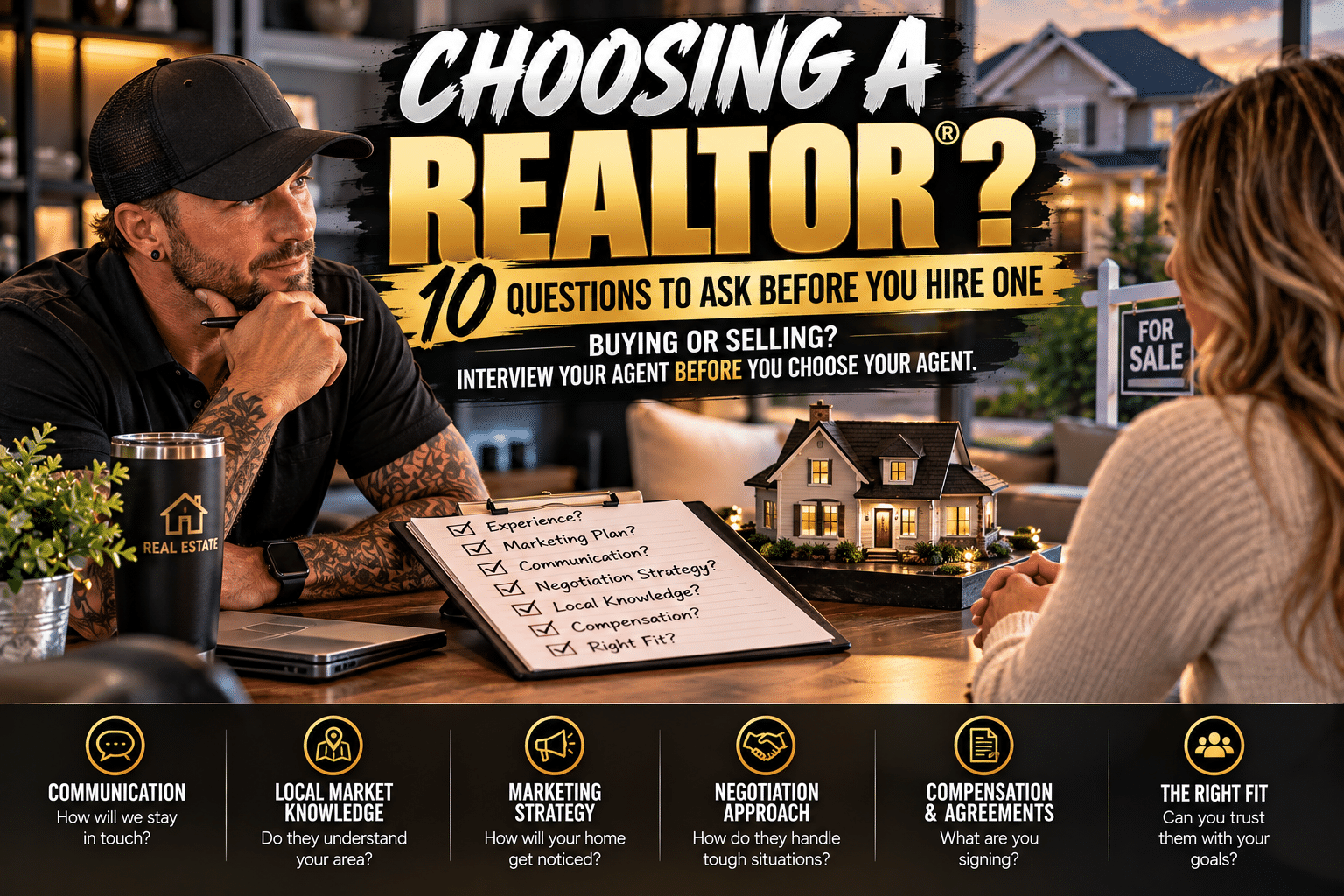

Choosing a REALTOR®? 10 Questions to Ask Before Hiring an Agent to Buy or Sell a Home
Choosing a REALTOR® can feel a little strange.
You’re potentially trusting someone to help you navigate one of the largest financial transactions of your life—but you may only spend 30 minutes talking with them before deciding they’re the one.
Maybe they were recommended by a friend.
Maybe you found them online.
Maybe you saw one of their signs.
Maybe they’re the first person who responded to your message.
Those aren’t necessarily bad ways to find an agent.
But they probably shouldn’t be the only reasons you hire one.
Whether you’re buying or selling a home, interviewing more than one real estate professional is perfectly reasonable.
And when you do, don’t be afraid to ask real questions.
Here are 10 I’d recommend starting with.
1. How Will You Communicate With Me?
This sounds basic.
It’s not.
Real estate transactions can move quickly, and communication problems can turn an already stressful situation into an unnecessarily frustrating one.
Ask the agent:
What’s the best way to reach you?
How quickly do you typically respond?
Will I communicate directly with you or primarily with someone else on your team?
How often should I expect updates?
There isn’t necessarily one correct communication style.
Some clients want frequent updates.
Others would rather hear from their agent when there’s actually something important to discuss.
What matters is understanding expectations before you’re under contract and wondering why nobody has called you back.
2. How Familiar Are You With the Area Where I’m Buying or Selling?
Knowing real estate and knowing a particular market aren’t exactly the same thing.
If you’re buying or selling in Clarksville or elsewhere in Middle Tennessee, your agent should be able to discuss the market you’re actually dealing with.
That doesn’t mean memorizing every house on every street.
It means understanding how to research local sales, competing properties, market activity and the factors that may affect your particular transaction.
For buyers relocating to an unfamiliar area, local knowledge can be especially valuable.
Ask the agent how they help someone understand an area rather than simply sending them listings.
3. If I’m Selling, How Will You Determine My Recommended Listing Price?
This is a big one.
Don’t simply ask:
“What can you sell my house for?”
Ask:
“Show me how you arrived at the price you’re recommending.”
A thoughtful pricing discussion should involve relevant market information—not just a number that sounds exciting.
Ask about comparable properties.
Ask about current competition.
Ask about recent sales.
Ask what differences the agent sees between your property and the homes being used for comparison.
And be cautious about choosing an agent solely because they suggested the highest listing price.
The highest number at the kitchen table doesn’t automatically become the highest number at closing.
You want to understand the reasoning behind the recommendation.
4. If I’m Buying, What Do You Do Besides Schedule Showings?
Opening doors is part of the job.
It shouldn’t be the entire job.
Ask a prospective buyer’s agent how they’ll help you evaluate properties and navigate the transaction.
How do they approach comparable sales?
What happens when you’re considering an offer?
How will they help you understand contract terms?
How do they coordinate with your lender, title professionals, inspectors and other parties involved in the transaction?
What happens if an inspection identifies a problem?
What happens if the appraisal creates an issue?
You don’t need an agent who pretends to be your inspector, attorney, appraiser or lender.
In fact, you shouldn’t want that.
You want someone who understands their role, knows when another professional needs to be involved, and can help keep the pieces of the transaction moving together.
5. If I’m Selling, What Does Your Marketing Strategy Actually Include?
“I’m going to market your house” sounds great.
But what does that actually mean?
Ask.
Will professional-quality photography be used?
How will the property be presented online?
Will there be social-media marketing?
Are open houses appropriate for the property and strategy?
How will showing activity and feedback be monitored?
How will the agent evaluate whether the marketing strategy is working?
What happens if the property isn’t receiving the expected response?
Marketing shouldn’t simply mean putting a property into the MLS and waiting.
And a seller should understand the plan before the listing goes live.
6. How Do You Approach Negotiations?
Here’s a question that can tell you a lot:
“Tell me how you approach a negotiation.”
Notice I didn’t say:
“Are you a good negotiator?”
Everybody is going to say yes to that.
Instead, listen to how the agent thinks.
Good negotiation isn’t always about being the loudest person in the room or trying to “beat” the other side.
Real estate negotiations can involve:
Price.
Seller concessions.
Closing dates.
Repairs.
Inspection issues.
Personal property.
Appraisal problems.
Possession.
Financing.
And sometimes several of those things at once.
A strong negotiator should be able to understand what matters most to their client, communicate clearly, evaluate the available options and help the client make an informed decision.
7. What Happens When Something Goes Wrong?
I love this question because real estate doesn’t always follow the perfect little timeline printed on a brochure.
Ask:
“Tell me about a difficult transaction and how you handled it.”
You’re not necessarily looking for drama.
You’re listening for problem-solving.
What happens when an inspection finds something unexpected?
What happens when an appraisal creates a problem?
What happens when deadlines get tight?
What happens when another party isn’t communicating?
What happens when emotions start running high?
You want to understand how the person sitting across from you behaves when the transaction stops being easy.
Because that’s often when an agent’s value becomes much more noticeable.
8. Who Will I Actually Be Working With?
This is particularly important when interviewing an agent who works on a team.
There’s nothing inherently wrong with working with a team.
Teams can provide tremendous resources.
But you should understand the structure.
Are you hiring the person sitting across from you?
Will another agent handle showings?
Will a transaction coordinator become your primary contact once you’re under contract?
Who handles negotiations?
Who do you call when you have a question?
Again, there isn’t necessarily a wrong answer.
You just deserve to know the answer before you sign anything.
9. How Are You Compensated, and What Am I Agreeing to When I Sign?
Don’t be uncomfortable asking about money.
You should understand how your real estate professional is compensated and what your representation agreement says.
Depending on whether you’re buying or selling, the agreements and compensation structure involved in your transaction can differ.
Ask the agent to explain:
What am I signing?
How long does the agreement last?
What services are you agreeing to provide?
What obligations am I agreeing to?
How is your compensation determined?
Under what circumstances could I be responsible for paying compensation?
And if something in an agreement doesn’t make sense:
Ask.
You shouldn’t feel pressured to sign a document you don’t understand.
A professional should be willing to explain their role, compensation and the agreement being presented to you.
10. Why Should I Choose You?
Yep.
Ask it.
But don’t just listen for a sales pitch.
Listen for whether the answer matches what you need.
Maybe you want someone who communicates constantly.
Maybe you’re relocating and need someone comfortable helping you learn an unfamiliar market.
Maybe you’re a first-time buyer who wants someone willing to explain everything without making you feel stupid for asking questions.
Maybe you’re selling and want someone who can clearly explain pricing, marketing and feedback.
Maybe you’ve bought and sold several properties and simply want someone efficient who gets to the point.
The question isn’t:
“Who is the best REALTOR®?”
It’s:
“Who is the right REALTOR® for this transaction and for me?”
Those aren’t necessarily the same question.
Pay Attention to the Questions the Agent Asks YOU
This might be just as important as anything else in this article.
You’re interviewing the agent.
But a good agent should also be trying to understand you.
If you’re selling, I’d expect questions about things such as:
Why are you considering selling?
What’s your ideal timeline?
What are your priorities?
What concerns do you have?
What improvements have you made to the property?
What does a successful sale look like for you?
If you’re buying:
Why are you moving?
What’s important about your next home?
What’s your timeline?
Have you spoken with a lender?
What has your previous buying experience been like?
What concerns you most about the process?
The agent shouldn’t need your entire life story.
But they should probably know what you’re trying to accomplish before explaining how they’re going to help you accomplish it.
Don’t Hire Someone Just Because They Tell You What You Want to Hear
This one matters.
Sometimes the answer you want isn’t necessarily the information you need.
A seller may want to hear that their home is worth a certain amount.
A buyer may want to hear that an extremely aggressive offer will definitely work.
But nobody can guarantee how another buyer, seller, appraiser, lender, inspector—or the market itself—is going to respond.
I’d rather have a difficult conversation early than create an unrealistic expectation that becomes a much bigger problem later.
You’re not interviewing an agent to find the person who tells you everything you want to hear.
You’re interviewing them to find someone you trust to tell you what you need to know—even when the two aren’t the same.
Experience Matters. So Does Fit.
Transaction history, market knowledge, education and experience can absolutely matter when you’re evaluating an agent.
But don’t overlook the human part of the relationship.
You’re going to communicate with this person during potentially stressful moments.
You’re going to discuss money.
You’re going to make decisions with them.
There may be disagreements.
There may be surprises.
There may be moments when you need somebody to slow everything down and explain what’s actually happening.
Ask yourself:
Do I trust this person?
Do they communicate in a way I understand?
Do I feel comfortable asking questions?
Are they listening to me?
Do they explain the reasoning behind their recommendations?
Those things matter too.
And Yes—Ask Me These Questions Too
If you’re interviewing REALTORS® to buy or sell a home in Clarksville or Middle Tennessee, don’t throw this list away when you get to me.
Ask me these questions too.
I’m not going to tell you that I’m automatically the right REALTOR® for every person.
That’s what the conversation is for.
Ask questions.
Compare approaches.
Understand the services being offered.
Understand the agreement you’re being asked to sign.
And choose the real estate professional you feel comfortable trusting with the process.
If that ends up being me, I’ll be honored to help.
If you’re still interviewing agents, that’s okay too.
This is your home, your money and your decision.
You should feel confident about the person sitting on your side of the table.
— Jamie Taylor, REALTOR®
Your Tennessee Homes Team
Haus Realty & Management
Serving Middle Tennessee
This article is provided for general educational purposes. Real estate representation, brokerage services, agreements and compensation can vary based on the brokerage, transaction and terms negotiated between the parties. Consumers should review agreements carefully, ask questions about terms they do not understand and seek appropriate legal or other professional advice when necessary.






